
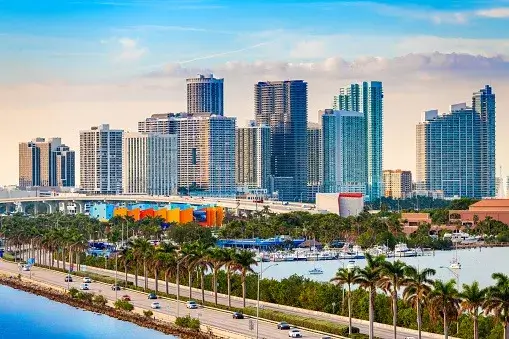
Miami’s new-development market is not one uniform product. A Brickell branded residence, an Edgewater waterfront condominium, a flexible-use building in Downtown Miami and a smaller furnished residence near Wynwood may all be marketed as “new construction,” yet they can have very different ownership rules, operating costs, financing considerations and delivery risk. A useful comparison starts with the neighborhood and then moves into the legal documents and the exact unit—not the rendering.
This guide organizes the active inventory on our Miami preconstruction page into four high-interest districts. Prices and incentives can change with each developer release, so request the current price sheet, floor plans and deposit schedule before relying on any listing snapshot.
Start with the right Miami neighborhood
Brickell: high-rise living near the financial district
Brickell has the deepest concentration of branded and luxury high-rise projects in the city. Buyers should compare the walk to transit and daily services, the exact view exposure, parking and storage, projected association costs and whether the residence is a conventional condominium or part of a hospitality-oriented program. The district name alone does not tell you how a unit may be rented or managed.
Review the current inventory on the dedicated Brickell new-construction condo page. Examples include The Residences at 1428 Brickell, St. Regis Residences Brickell and 2200 Brickell.
Edgewater: bayfront exposure with building-by-building differences
Edgewater is a residential district north of Downtown along Biscayne Bay. Direct water exposure, setbacks and view corridors vary by building and unit. Compare the selected line and orientation, insurance assumptions, flood disclosures, association budgets, construction stage and access to parks and causeways. A general “waterfront” label is not a substitute for the current site plan.
Use the Edgewater new-construction condo page to compare projects such as EDITION Residences Miami Edgewater, Villa Miami and Aria Reserve Miami.
Wynwood and Midtown: product type matters
Wynwood’s residential market is growing around an established arts, dining and retail district. Unit sizes, furniture requirements, parking, rental rules and management programs can vary substantially. Buyers considering income potential should ask for the actual declaration and management terms instead of assuming that every project permits short stays.
Compare the focused inventory on the Wynwood new-construction page, including NoMad Residences Wynwood, Diesel Wynwood and The Rider Wynwood.
Downtown Miami: several submarkets in one label
Downtown includes the Central Business District, Miami Worldcenter and nearby Arts & Entertainment and Overtown edges. Buildings can be conventional residences, branded products, condo-hotels or flexible-use developments. Confirm the precise subdistrict, the walking route to transit, nearby construction, view protection and operating model.
The Downtown Miami new-construction page includes projects such as Waldorf Astoria Residences, The Crosby Miami Worldcenter and Aston Martin Residences.
A seven-part comparison that works across projects
- Ownership and use: identify whether the offering is a conventional condominium, branded residence, condo-hotel or another flexible-use product. Check rental duration, management obligations and owner-use restrictions in the current documents.
- Developer and filing: verify the legal developer entity, its public registration, the condominium filing and available permit history. Marketing brand names and legal entities are not always the same.
- Deposit schedule: compare the total deposits, when each installment is due, the named escrow agent and the contract provisions governing the funds. Read our Miami deposit, contract and closing timeline.
- Delivery and closing: distinguish an estimated occupancy window from a binding deadline. Ask what notice is provided, what must be completed before closing and which costs become due at closing.
- Monthly ownership cost: examine projected association fees, insurance, reserves, utilities included, parking, storage and mandatory club, furniture or management charges.
- Exact unit: compare usable layout, orientation, balcony, ceiling height, columns, mechanical spaces and the possibility of future view obstruction.
- Exit and financing: review assignment provisions, financing contingencies, resale restrictions and the tax or legal implications relevant to your residency. Foreign buyers can use our Miami closing-cost planning guide as a question list for their professionals.
Use primary records, not only sales material
The Florida Department of Business and Professional Regulation explains that developers must submit specified condominium documents before offering residential units and provides official condominium filing guidance. Miami-Dade County also provides public tools for building permits, plans and certificates. The Miami Downtown Development Authority maps help distinguish Brickell and Downtown subdistricts, while the Wynwood Business Improvement District provides district-level context.
Those resources do not replace a lawyer, accountant, lender or property inspection. They make your questions more precise. For a repeatable process, follow our Miami developer and project verification checklist.
How preconstruction.info keeps the comparison useful
Project pages are organized by actual city and neighborhood, use canonical URLs and show the latest stored update date. Records that still need a current primary source for pricing, deposit, occupancy or availability remain in a verification queue rather than being labelled fully verified. That distinction matters because a project can be real while a specific price or incentive has already changed.
To narrow the market, start with Brickell vs. Edgewater vs. Wynwood vs. Downtown Miami, then request the live documents for the two or three projects that fit your intended use and budget.
Last reviewed August 2026. This article is general real-estate information, not legal, tax, accounting or investment advice. Project terms and government requirements may change; verify them with the current contract, official records and qualified Florida professionals.
Get Miami New-Development Updates
Receive useful launch news, verified pricing updates, incentives, and buyer guidance. No spam; unsubscribe anytime.
